
Journal
What Swim Goggles Taught Me About Testing
By Fred Berns, Co-Founder
Published September 7, 2026 · Last updated September 7, 2026
This piece is a personal essay drawn from the author's time at Hammacher Schlemmer, not a product review. cobesa has no relationship with any goggle manufacturer or robotics company mentioned or implied here.
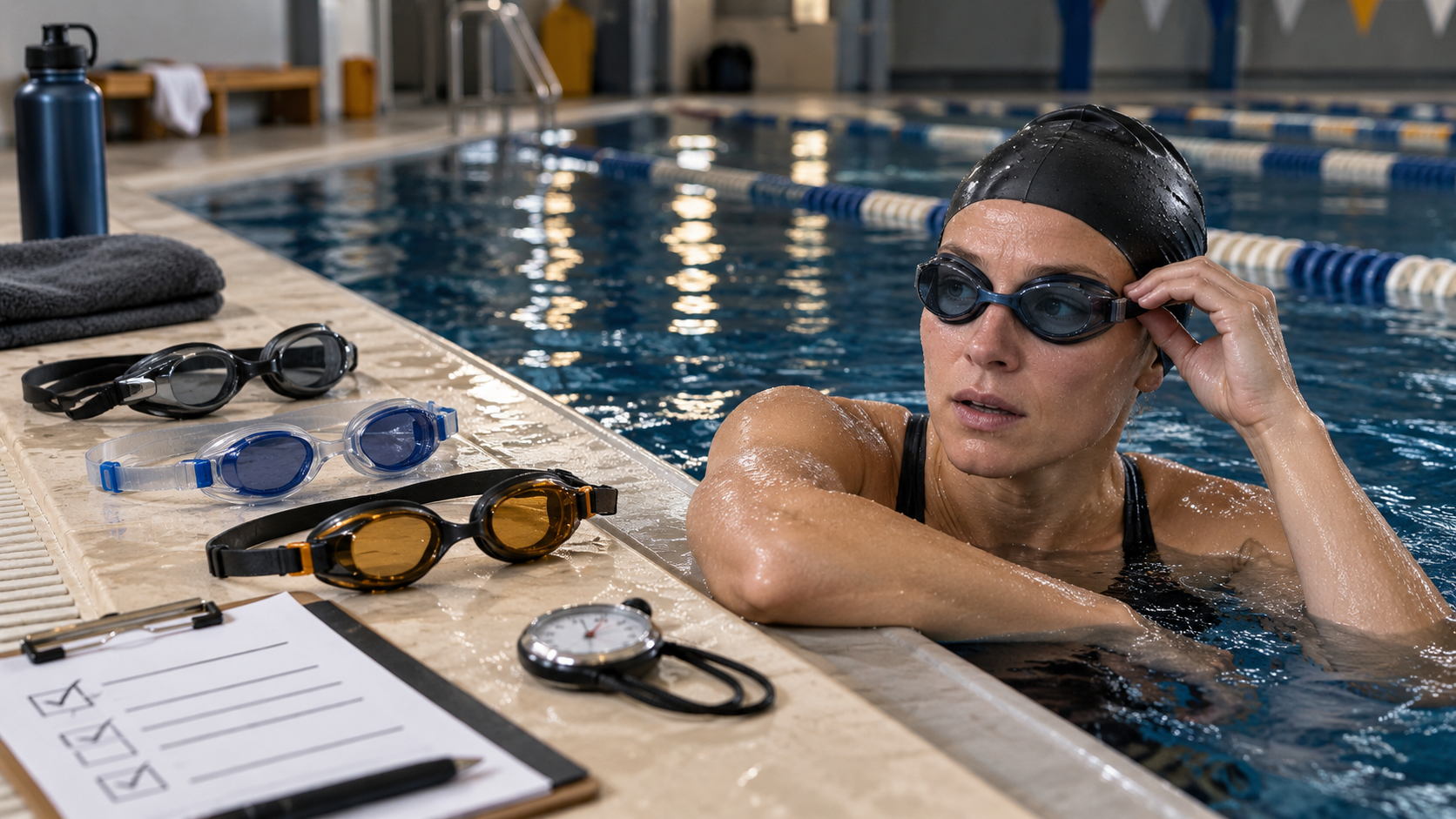
The Hammacher Schlemmer Institute was known for scientific, controlled lab tests, designed to emulate how products really get used. Swim goggles could not honestly be tested in a lab in a competent way that accurately resembled how anyone would actually use them.
I remember the goggles category well because it was crowded: dozens of models could all claim watertight seals, anti-fog lenses, and a comfortable fit. A shopper standing in a store had no way to tell which company had actually solved the leakage problem and which one had only solved the problem of writing a convincing label. The only way to separate the two was to put real goggles on real faces and send them into real water.
Instead of a bench test, the Institute commissioned a panel of experienced swimmers. Each swimmer wore a single model, swam real laps in a real pool, reported on fit, comfort, leakage, and fogging, and then moved on to the next pair. Nobody compared two goggles side by side in a lab. Every judgment came from a swimmer who had actually been in the water.
The winning goggles held up over the length of a swim, not just at the moment they went on. Panelists reported no leakage after ten laps. The goggles that fell short began to leak after only two.
Comfort told the same story in a different register. One panelist said the winning pair fit perfectly. The pairs that fell short were described as stiff, and one dug into the swimmer's nose within minutes.
Suction followed the same pattern of degrading over time, not failing on contact. The losing models felt fine going in, then lost their seal over the length of a swim, right when a swimmer had the least ability to stop and readjust. One pair failed completely. It came off the moment a swimmer dove into the pool.
Visibility was its own category of failure, and it only appeared once a swimmer's face was actually in the water. The winning lenses carried an anti-glare coating and stayed clear underwater, and panelists reported being able to see in every direction without the lens fogging or distorting the light. Lesser pairs looked identical in a photograph. Only a swimmer with her eyes open underwater could tell the difference.
None of that shows up on a specification. A goggle strap either exists or it does not. A lens is either anti-fog coated or it is not. Nothing on a label captures what happens to suction ten minutes into a swim, or what a nose bridge feels like on lap eight. The only way to find out is to put the product in the water and leave it there long enough for the truth to surface.
This is why real-world tests are so important: not to confirm a feature, but to watch that feature hold up, or fail, under the exact conditions a customer will actually create. A box can claim anything. Only a swimmer, ten laps in, can tell you whether the claim was true.
Manufacturers report on the true performance of their products under laboratory conditions. True in a controlled setting and true after ten laps of an actual swim are different claims entirely, and only one of them matters to the swimmer wearing the goggles.
cobesa exists to close that same gap for a much larger and more expensive purchase. We lean on the same principle that put swimmers in a pool instead of goggles on a lab bench: aggregate real experience, survey and interview the people actually living with the product, and weigh what happens in an actual home over what a spec sheet promises in a lab. A robot's marketing page can describe its balance, its grip, its battery life, in terms every bit as confident as a goggle box promising a watertight seal. Confidence on a page has never been the same thing as performance in a home.
Keep reading