
Journal
Who is actually doing the work?
Manufacturers publish real footage. Real footage does not tell you who was in control of the robot.
By Chris Sachs, Co-Founder
Published September 4, 2026 · Last updated September 4, 2026
Every claim below links to a manufacturer's own page. cobesa has no hands-on access to any robot named here, and no affiliate relationship, sponsorship, or supplied hardware from any manufacturer named here.
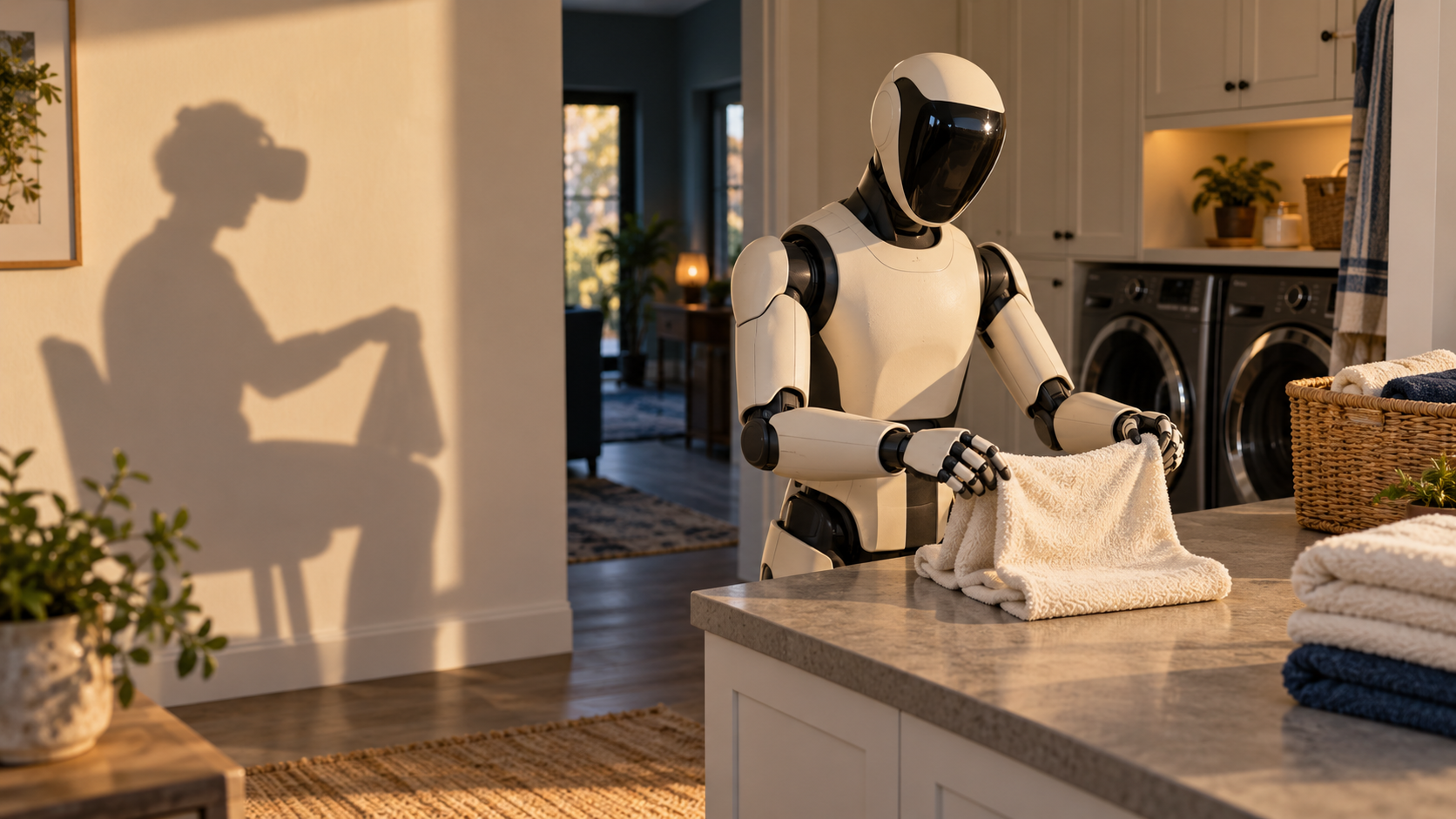
Almost every humanoid robot video a manufacturer publishes is real. That is exactly what makes them so hard to learn anything from.
The clip where the robot folds a shirt happened. So did the clip where it loads a dishwasher. What neither clip tells you is whether the robot decided to do that on its own, or whether a person in another building wearing a VR headset was moving its arms for it. Those two videos look identical on your phone. One of them is a product. The other one is a very expensive puppet, and I say that with real affection, because the puppet is how the product eventually gets built.
Which chores does a home humanoid do without a person in the loop?
Here is the honest answer, and it is narrower than either the hype or the backlash. The manufacturer will usually tell you which tasks are which, if you read the product page instead of the keynote.
On 1X's NEO product page, the autonomy callout cycles through tasks like walking to a person and putting away dishes. A few scrolls down, the Scheduled Expert Mode section, where a 1X employee connects remotely and guides the robot through a chore it does not know, is illustrated with laundry. 1X's launch announcement says the same thing in sentences: NEO arrives able to open doors for guests, fetch items, and turn off the lights at night, and for any chore it does not yet know, an owner can schedule a 1X Expert to guide it through the task while the job gets done. Both lists are on 1X's own site, published by 1X, at the same time.
What separates those two lists tells you most of what to expect from a home robot today. Opening a door, carrying something light, and holding a conversation that remembers you have one thing in common: none of them require handling an unpredictable object. A door handle lives in the same place every single day. A water bottle is rigid and easy to grab. Talking is a software problem, and the software in these robots is years ahead of the hands. Chores are hard for the exact opposite reason. Laundry is soft, dishes are fragile and never stacked the same way twice, and your kitchen counter looks different every night.
That is a real distinction, and it is not the one the marketing is built on. The scenario I keep coming back to is the one I actually want solved. You are on a call you cannot leave, there is a package sitting on the porch, a load waiting in the dryer, and the thing you need is on the kitchen counter twenty feet away. If a robot handled even two of those, I would pay real money, and I have been waiting for that robot since the first smart gadgets I bought for the house. Wanting it is exactly why I read the product page carefully instead of the highlight reel.
Is teleoperation the scandal here?
No, and this is the part that surprises people, so let us sit on it for a second.
1X states on its own site that NEO works autonomously by default, and that for a chore it does not know, an Expert from 1X can remotely supervise its actions at scheduled times, helping NEO learn while getting the job done. 1X also lists Remote Control as a feature: pilot your NEO from anywhere in the world through the mobile app and a VR device. They published all of that on the product page. They did not get caught at it. Disclosed, not hidden, and credit where it is due.
It does mean the robot in your living room is doing work for you and collecting training data from you at the same time, and that sometimes there is a person behind its eyes. When a chore gets done that the robot has not learned yet, or when it runs into something it cannot handle on its own, there is a good chance a person is remotely guiding it through. Somewhere out there, a guy you'll never meet has camera access to your bedroom. That's not a hack. That's Tuesday.
It is worth holding that next to what plenty of people already pay for. If you have a cleaning service, someone you have never really met has a key, walks through your bedroom, and knows what your house looks like on a Tuesday afternoon while you are at work. Same with a dog walker, a contractor, or the tech who comes out to fix the dishwasher. Most of us made peace with that a long time ago, and we handle it with references, scheduling, and a company that answers the phone when something goes wrong. A person guiding a robot through your living room is a version of the same trade. What is different is that it is new, the controls live in an app instead of a conversation at your front door, and the norms for how it should work have not been set yet.
None of that should talk you out of buying a robot. It should just tell you which document you are reading. There is what the salesperson tells you, and there is what 30,000 miles tells you, and in humanoid robots the mileage barely exists yet.
That is the whole thing. Before you ask whether a robot can do a task, ask who was doing it in the footage you watched.
Questions people ask
Are humanoid robot demos fake?
No. The footage is almost always real. The part that goes unstated is who was in control, and whether the run you are watching was the first attempt or the fortieth. Ask who was driving before you decide what the video proved.
What can a humanoid robot actually do at home in 2026?
Going by 1X's published material for NEO: open doors for guests, fetch and carry light items, turn off lights, and hold a conversation with memory of earlier context. Chores it has not learned route through Scheduled Expert Mode, where a 1X employee guides it remotely.
What is teleoperation, and can someone see inside my house?
Teleoperation means a person controls the robot remotely while seeing through its cameras. 1X publishes both an owner-facing Remote Control feature and a Scheduled Expert Mode, and answers questions about Expert access and data use in the FAQ on its product page. Read those answers yourself before you order. If that arrangement does not sit right with you, that is a complete and reasonable reason not to buy one.
How much does a home humanoid cost right now?
1X lists $20,000 for Early Access with priority delivery in 2026, or $499 per month on subscription shipping later, with a $200 deposit to place an order. Deliveries go primarily to the U.S. in 2026 and to other markets starting in 2027. Verified against 1X's own pages on September 4, 2026.
So why would anybody buy one right now?
Because presence, telepresence, and light fetching are real, and because some people genuinely want to help raise this technology and can afford the tuition on being early. That is a good reason. It is a different reason from "it will do my chores," and mixing up the two is the most expensive mistake you can make buying one of these.
How does cobesa decide what a robot can actually do?
Every claim gets traced to the manufacturer's own page, separated into what the robot does on its own and what a person is guiding, and stamped with the date it was verified. cobesa has no hands-on access to these robots yet and does not publish hands-on findings it has not earned.
What to do next
If you are shopping: open the manufacturer's product page, not the highlight reel, and sort the tasks it names into the ones the robot does on its own and the ones a person guides remotely. If you cannot tell which is which, that is your answer for now.
If you want cobesa to do that sorting for you, start here and read the journal.
Keep reading