
Journal
When Your Home Robot Hurts Someone, Who Pays?
Your robot damages a $12,000 appliance, gouges your hardwood floor, or sends a guest to the hospital. The responsible party could be the manufacturer, your insurance company, or you.
By Fred Berns | October 25, 2026 | cobesa Journal
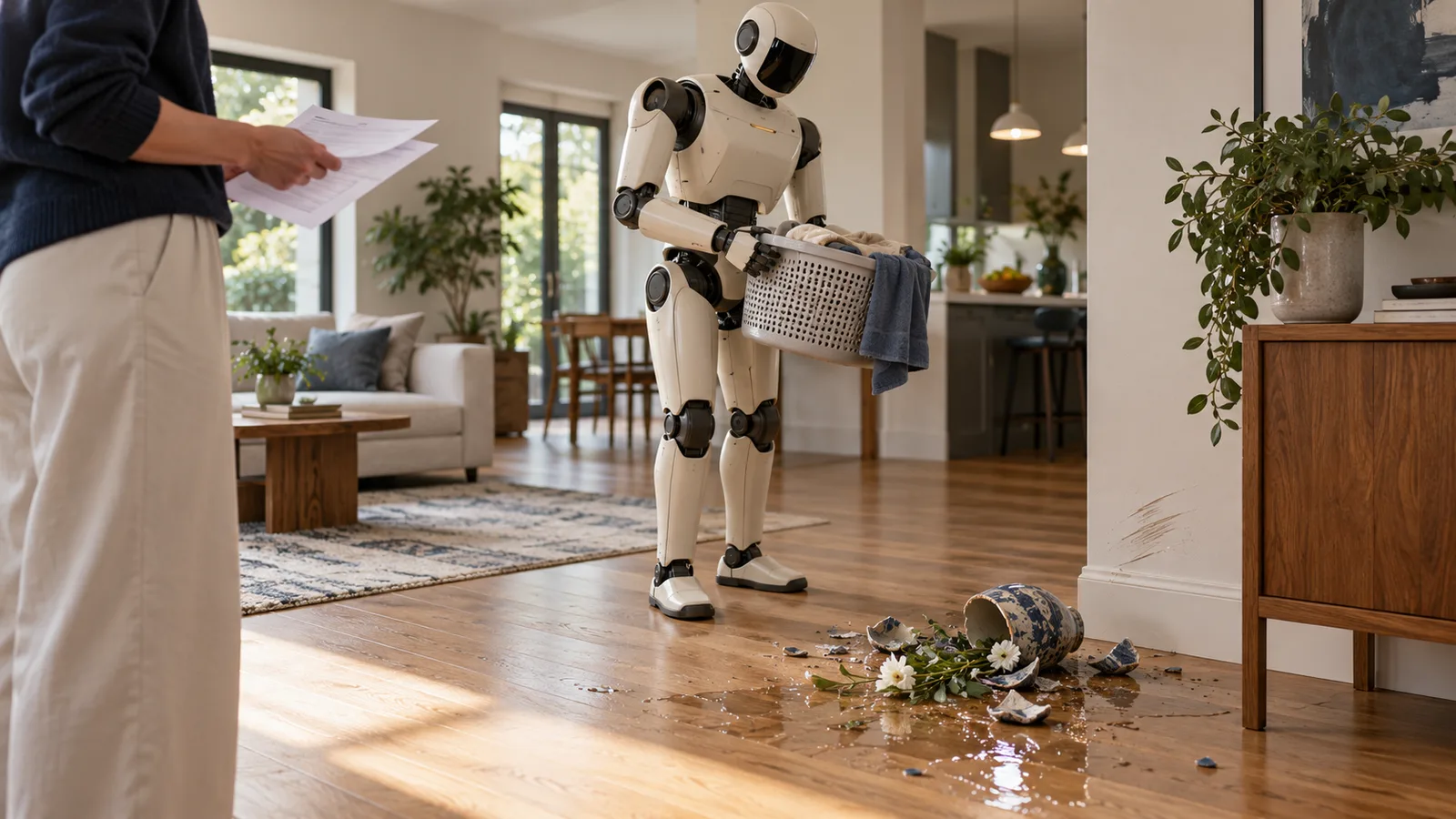
Imagine you have bought a humanoid robot to help around the house. While putting away groceries, it damages your $12,000 refrigerator. Or, it scratches your hardwood floor while moving furniture. These are expensive mistakes, though probably not life-changing.
Now imagine something more serious. Your robot is carrying a laundry basket, fails to recognize someone walking behind it, and knocks a visiting friend to the floor. The friend breaks a hip. The medical bills, the damages, and potentially the legal costs all land somewhere, and where they land depends on who is responsible.
Situations like these will become common as humanoid robots move from demonstrations into ordinary homes. Existing laws and insurance policies provide some answers, but they were not necessarily designed with autonomous household helpers in mind.
Responsibility and insurance are two separate matters
Legal responsibility and insurance coverage are easily confused, and they are not interchangeable. Responsibility for an accident could rest with any of several parties: the homeowner, the manufacturer, a software provider, a remote human operator, or some combination of them. Coverage depends on the policies those parties maintain and on the circumstances of the accident.
Your homeowners insurer might cover an accident even when a defective product ultimately caused it, and the insurer could then seek reimbursement from the responsible company. A manufacturer might also be legally responsible for an injury without carrying enough applicable insurance to make compensation straightforward. The distinction matters for each of three kinds of accidents.
Your robot damages your home or belongings
Suppose your robot causes $12,000 in damage to your refrigerator. You might reasonably assume your homeowners insurance would pay for the repairs.
Homeowners insurance does not necessarily pay.
Homeowners insurance generally separates coverage for the structure of your home from coverage for personal belongings. Many conventional policies cover the dwelling against accidental physical loss unless the cause is excluded, but cover personal belongings only against specified causes of loss. The distinction matters because your flooring, built-in appliances, and movable appliances can fall under different provisions. Even when the damage is otherwise covered, exclusions or limitations for marring, scratching, wear and tear, or mechanical breakdown can apply.
You might be able to seek reimbursement from the robot's manufacturer, but you will generally need a legal or contractual basis for holding the company responsible. A robot causing damage is not, by itself, proof that the robot was defective. A manufacturing flaw, unsafe design, inadequate warning, or negligent remote operation could create a claim, while an ordinary mishap may not.
A homeowner could therefore face a frustrating combination: a costly repair, no insurance payment because of the deductible or coverage limitations, and no straightforward claim against the manufacturer. A manufacturer's promise to repair or replace a malfunctioning robot is not enough. A robot warranty and coverage for the damage the robot causes are two very different protections.
Your robot injures someone visiting your home
The stakes rise considerably when the damage is to a person. Suppose your robot collides with a visiting friend and causes a serious injury. The friend faces medical bills, rehabilitation expenses, lost earnings, and other damages.
Your homeowners policy's personal liability coverage becomes potentially important here. It generally protects you against covered claims for bodily injury or property damage to others for which you are legally responsible, and it may also provide a legal defense against covered lawsuits. Many homeowners policies also include a separate medical-payments-to-others provision that can pay limited medical expenses without first establishing legal liability.
The outcome of a claim depends on the facts: whether the robot was working autonomously, whether you gave it unsafe instructions, whether the manufacturer had warned against operating it near other people, and whether a remote human was controlling it. It also depends on a more basic matter: whether your insurer treats an autonomous humanoid's conduct as a covered personal-liability exposure. Standard descriptions of homeowners insurance establish that personal liability protects against many accidents. They do not establish that every autonomous robot accident will be covered. The actual policy language and exclusions control, and the insurer may first need to determine whether the homeowner was legally responsible at all.
Your robot injures you
Injury to the owner follows a different path. If your robot injures a guest, your homeowners liability insurance may be relevant. If it injures you, your homeowners liability insurance generally will not compensate you for your own injuries, because personal liability coverage is primarily designed to protect you when you are legally responsible for harming someone else.
Your health insurance may cover eligible medical treatment, subject to its own terms, but it does not necessarily compensate you for lost income, ongoing disability, pain and suffering, or other losses. You might have a claim against the manufacturer or a remote-operation provider if a defect or negligent conduct caused the injury. That claim depends on what actually happened and on whether a legally responsible party can be identified.
Anyone planning to use a robot for elder care, mobility assistance, or other tasks involving close physical contact should pay particular attention to this exposure. The consequences of an accident there are much more serious than a damaged appliance.
Autonomous cars offer the closest comparison
Self-driving vehicles provide the most useful comparison. Autonomous vehicle technology has already forced regulators, insurers, manufacturers, and courts to confront accidents in which the vehicle makes its own operating decisions.
California, for example, requires autonomous-vehicle manufacturers operating under its regulatory framework to demonstrate $5 million in financial responsibility through insurance, a bond, or self-insurance. Waymo also maintains a public collision-reporting process for people involved in incidents with its vehicles. Neither fact means that Waymo automatically accepts liability for every accident involving one of its cars, but together they show a relatively well-developed system for identifying an operator, reporting incidents, and establishing financial responsibility.
The household humanoid has nothing comparable that cobesa could find. Its research identified no nationwide U.S. requirement imposing a similarly explicit insurance or financial-responsibility obligation on consumer humanoid manufacturers. The car comparison also has a limit: autonomous vehicles operate under specialized motor-vehicle laws, and those laws do not automatically apply to a robot carrying laundry through a living room.
The underlying principle still applies. When a company introduces a powerful autonomous robot into everyday human environments, consumers should expect to know whether someone has the financial resources, and the insurance, to stand behind its operation.
Who is operating the robot changes the analysis
Whether a robot was acting autonomously or being remotely controlled can matter a great deal. Three scenarios show how.
Autonomous operation. The robot independently chooses its route, misjudges a turn, and injures someone. The investigation might focus on the robot's design, sensing capabilities, software, safety protections, instructions, and the homeowner's use of the product.
Operation by a manufacturer employee. The employee remotely misjudges a movement and knocks someone over. The operator's conduct becomes relevant, as does the possible responsibility of the company that employs or supervises that person.
Operation by the homeowner. The homeowner directs the robot into an unsafe situation, and the homeowner's own conduct becomes a more significant factor.
These theories of responsibility are not mutually exclusive. A manufacturer can still be liable for a defective robot when someone else was operating it. Hybrid operation, in which a robot works autonomously most of the time and a remote human temporarily takes control, makes the distinctions murkier still.
Ten items to get in writing before a humanoid comes home
Until manufacturers and insurers offer clearer answers, consumers should request the following in writing:
Ask the manufacturer
- Property damage: Ask what the manufacturer will reimburse if the robot causes $12,000 or more in damage to appliances, cabinetry, walls, flooring, or other belongings.
- Injuries to you: Ask what protection the manufacturer provides, beyond any available health insurance, if the robot injures you or another insured household member.
- Remote operation: Ask whether responsibility changes when the manufacturer, a contractor, or the homeowner is remotely controlling the robot, and what insurance protects against mistakes by remote operators.
- Manufacturer insurance: Ask whether the manufacturer maintains applicable product-liability and operational-liability insurance, and request the coverage limits, exclusions, and claim procedures.
- Investigation and evidence: Ask whether the manufacturer will preserve the robot's event logs, software version, operating mode, and remote-control records after an incident, and make relevant information available for investigating a claim.
- Contractual protections: Read what the final purchase or subscription agreement, warranty, exclusions, indemnification provisions, and dispute-resolution terms say about accidents involving bodily injury or property damage.
Ask your insurer
- Damage to your home: Ask whether your homeowners policy covers damage the robot causes to the structure and to your belongings, and how the deductible and any exclusions for marring, scratching, wear and tear, or mechanical breakdown apply.
- Injuries to others: Confirm whether your homeowners liability insurance covers the resulting claims and legal defense when the robot injures a guest or neighbor, and whether your umbrella policy provides additional coverage.
- Autonomous robots: Confirm whether your insurer treats an autonomous humanoid's conduct as a covered personal-liability exposure, and whether any policy exclusions apply to it.
- Remote operation: Confirm whether your coverage still applies when the manufacturer, a contractor, or someone else is remotely controlling the robot.
Those answers determine whether a robot is merely impressive technology or a product whose ownership risks are acceptable.
Someone has to stand behind the robot
A robot does not need to be dangerously defective to cause an expensive accident. It needs only to make a mistake while handling something valuable or moving near someone vulnerable.
Appliances, cars, and other household products fail, and the world has built expectations, laws, warranties, insurance arrangements, and claims processes around those failures. Humanoid robots will need comparable consumer protections.
A buyer should know who is accountable when a robot does something to the owner or to someone else, and should have that answer in writing.
Research note: This article examines U.S. insurance and liability principles as of October 22, 2026. Coverage and legal responsibility depend on state law, individual policy wording, contracts, and the circumstances of an incident. This article is general consumer information, not legal or insurance advice.
cobesa has no affiliate relationships with, sponsorships from, or manufacturer-supplied units from any company named in this piece.
Spotted an error? Contact corrections@cobesa.ai.